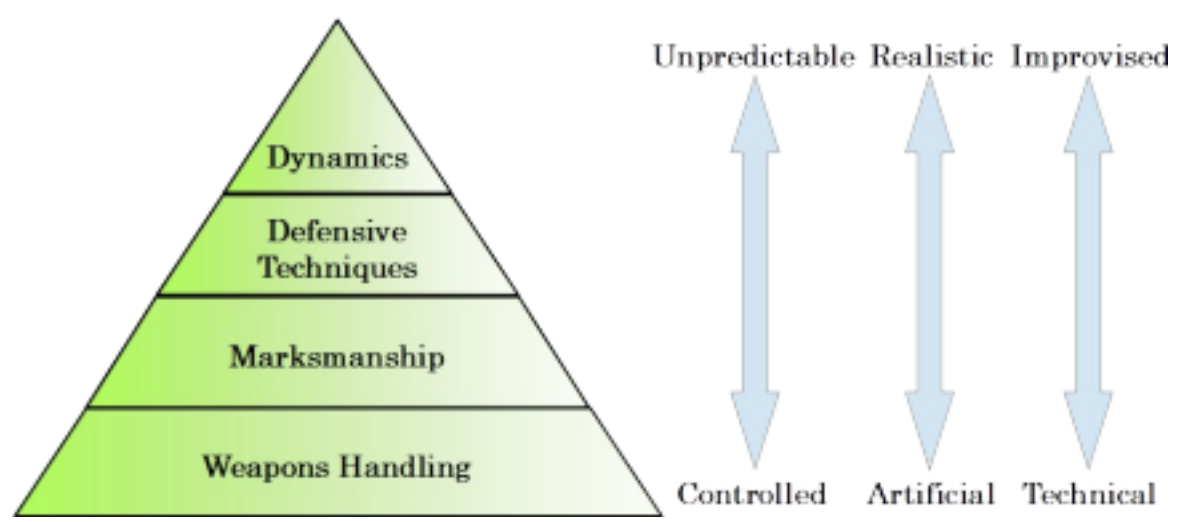
Now that you understand the Training Pyramid and how these various categories of defensive skills relate to one another, let’s look at what this means in practical terms for how you should approach your training.
Like any other pyramid, we start at the base. As I mentioned earlier, your foundation of Weapons Handling can never be too strong. Unfortunately, a great many gun owners dismiss these skills as marginally important. However, once you’ve built the foundation, you can confidently and competently move up to the next level.
This is not to say that you must obtain complete mastery of each level before touching anything at the next level. (In fact, for a true student of the gun, you never obtain complete mastery of any of these skills.) However, you must have more than a basic level of knowledge and proficiency at each level before moving to the next.
If you begin working on the next level and you find that the skills at the lower level(s) start falling apart, you’re working up the pyramid too quickly.
Only build up as fast as you can without sacrificing proper performance.
Set yourself up for success by building one level at a time.
Training Changes As You Build
The style of training you undertake will change depending on which level you are building. When you are building your foundation, your training will be very controlled and predictable. You’ll probably be on a traditional shooting range, under the watchful guidance of an instructor who is walking you step-by-step through the technique, topic, or procedure. In fact, a sizable chunk of the training will probably not even involve shooting.
Some say that this kind of training will not prepare you to defend yourself. They say that only realistic, stressful training will ensure you can prevail against a criminal attack. However, stress-filled and unpredictable training is unsuitable for building your foundation. That style of training should be reserved for the upper levels, especially the Dynamics level.
The most effective Dynamics training puts you in stressful situations, where the situation is unpredictable and rapidly changing. It should replicate, to the extent possible, the exact conditions you’ll find yourself in when your life is truly in danger. And under such conditions, you’ll be less concerned about perfect technique and more concerned about effectively resolving the situation as the victor.
So, “square range” training is not obsolete, as some suggest. In fact, it is necessary. However, it does have limitations, which become more apparent the higher you build your pyramid. As you reach higher levels, you will need training that allows you to exercise your skills in a more fluid and improvised manner.
Assessing Defensive Techniques
So far, we’ve talked a bit about the skills involved at each level, but what about the specifics of how those techniques are performed? In truth, there are many perfectly valid ways to accomplish most items on the list of topics above. However, there is also a right way and a wrong way to do everything. In fact, as an old instructor of mine liked to say:
“There are several ways to do something right. There are infinite ways to do something wrong. If an instructor or school says that their way is the only way, you should probably look elsewhere.“
Even though there is more than one way to do things, you will want to find a single method that you use for each task or purpose. Having more than one way to accomplish the same purpose will significantly increase your response time under stress, because your brain has to decide which technique you’ll use at that moment. (This is a principle known as “Hick’s Law”.) Having a single method eliminates this decision point and improves your response time.
So how do you know if a technique is “right”? For defensive shooting, a technique must meet four criteria:
- Effective: Each technique has a purpose. The technique you choose must be expected to reliably accomplish its intended goal. It should also accomplish its purpose without inducing any negative side effects.
- Efficient: You have no time to waste in a gunfight. A technique should accomplish its intended purpose in as little time as possible.
- Practicable: You must be able to reasonably expect that you can perform the technique, without having to warm up, even when accounting for the stress you’ll experience in a gunfight.
- Justifiable: Your actions must be seen as reasonable by others. To the extent possible, you want to minimize your likelihood of facing criminal or civil legal liability after a self-defense encounter.
If a technique meets these four criteria, you can consider it “right” for the purposes of defensive shooting.
By all means, compare and contrast various methods, but once you find one that meets the above criteria and works well for you, stick with it. Retraining previously ingrained skills is time-consuming and challenging.
Keep The Main Thing The Main Thing
When training, you should focus on the skills that are most important to you in a defensive encounter; that is, the skills that will apply in the vast majority of situations. It is helpful to keep the Training Pyramid in mind while making this assessment, and remember that the lower the skill is on the pyramid, the more likely you are to need it. Weapon Handling is important, not only in 100% of defensive encounters, but virtually any time you are handling a firearm. Marksmanship is vital in 100% of situations that require you to shoot.
Correspondingly, your training should constantly be reinforcing those skills, even as you work on the upper levels. If you ever reach the point where your fundamentals start to suffer, you’re probably training beyond your current capabilities.
It is when you reach Defensive Techniques that you might start to run into trouble. Because of the sheer volume of skills, topics, and techniques at this level, you must prioritize which of these you are going to spend the most time training on.
It’s common to evaluate a defensive training course based on the sheer number of techniques that it teaches, but this alone is a poor measure of the course’s content. Many defensive courses will spend time working on skills like shooting under a car, supine (on your back) shooting, starting with your gun in a disassembled state, and so forth. These skills, while useful in certain circumstances, are niche skills that only apply in relatively rare situations. Your training time is better spent on things that you’ll need in 90% of situations, given how most self-defense encounters play out. This is something I call the 90% Principle:
Spend 90% of your training time on the skills you’ll need 90% of the time.
In my opinion, here are a few critical defensive skills that should feature prominently in any training program. This is by no means an exhaustive list, but a training program that lacks any of them is, in my view, severely deficient. And bear in mind, these skills are in addition to the weapons handling and marksmanship, which should be interwoven throughout any training course.
Shot-Placement Strategies: Where you should try to hit your adversary, and under what circumstances.
Weapon Presentation: Rapidly bringing the weapon on target from a ready position or the holster.
Escalation of Force: Resolving a situation using the minimal amount of force necessary.
Situational Awareness: Using your awareness to avoid an encounter, and staying aware of your surroundings during and after an encounter.
Moral and Legal Decision-Making: Understanding the moral, ethical, and legal ramifications to enable you to make sound decisions about when and where to use deadly force.
Train For The Worst
Make no mistake: The 90% Principle does not mean that you should not train for contingencies. In fact, I’m a firm believer in Murphy’s Law: If it can go wrong, it will. Therefore, the 90% Principle actually mandates that you should train for the possibility that something will go wrong so that you have a plan and the necessary skill to fight on.
For instance…
What if your weapon malfunctions during the fight?
What if you shoot the gun empty?
What if your adversary continues to attack after you shoot him? After you shoot him again? What if he’s wearing body armor, or hopped up on drugs?
What if he hides behind a brick wall?
What if there are innocent bystanders?
What if he uses a human shield?
What if you are injured during the attack?
What if there is more than one attacker?
What if you’re attacked in low light?
Your overall training plan should feature answers to these questions, among others.
Finding a Trainer
So how do you go about finding an instructor and training course that will provide you the training that you need? There is no one right answer, but here are a few guidelines that should steer you in the right direction.
Training takes time: Expect to spend a few days training, even if those days are spread out over some period of time. And anyone who claims to be able to teach you what you need to protect yourself in 8 hours or less is straight up lying to you (or lying to themselves).
You get what you pay for: You’ll find a wide range of options and costs when it comes to training. You’ll find classes for as little as $25-$50, while quality training costs up to $350 per day. I suggest erring on the side of spending too much rather than too little. If you have a $50 life, get $50 training.
Avoid “boot camps”: Unless you really get off on being shouted at and cursed out, steer clear of courses that promote a militaristic or stress-filled training environment, especially when you’re first starting out. You will learn better when you can focus on learning, rather than on avoiding the wrath of the instructor. There is a place for stressful training, but that place is in an appropriate training scenario or drill, and only then, once you are training on Dynamics.
Police or military background is not critical: Many people naturally think that a current or former police officer or military member will have the background needed to teach them. However (and I say this as a military man myself), this is often not the case. Even if such people have proficiency with a skill, they can’t necessarily teach that skill to you. Furthermore, some are often unable to make the transition to applying those skills to a civilian context, and teach concepts that are only considered justifiable in a law enforcement context. The most important measure of an instructor is not their level of skill, but their ability to develop skill in their students.
Find their current and former students: The best way to determine an instructor’s effectiveness is by hearing what their students have to say. At the very least, you should be able to find some testimonials of the results students got from a course or instructor.
Professionals will give you professional results: Most firearms instructors teach as a hobby or side business. They have a full-time job and teach occasional classes. Most of the time, these instructors will not give you the results that you will get from a professional instructor, whose job is teaching people to shoot. A full-time instructor or training academy will have vastly more experience and expertise in teaching these skills, and is much more likely to give you the results you need.
YouTube is not training: You might be tempted to learn what you need from the Internet. I say this with all love and care: Don’t even think about it! First, it can be very difficult to sort the quality information from the rubbish on the Internet. And let me assure you, there is plenty of rubbish out there. Furthermore, like all motor skills, skill at arms is not something that most people can learn simply by watching someone else do it. Would you learn to ski or do gymnastics from the Internet? Almost inevitably, bad habits will creep in, and without the watchful eye of a coach to correct you, you’ll ingrain those bad habits.
It’s a Process
Does all this seem little overwhelming? That’s OK! In fact, that’s normal. When my eyes were opened to the full range of skills that I needed to develop, I was a little bewildered too.
Training isn’t something that happens overnight. It’s not a one-time event. It’s something that you’ll do repetitively throughout your life. We’ll discuss this more in the remaining steps. For now, don’t worry! There might be a lot to it, but it’s not as hard as it might seem.
Aaron is a retired Army Reserve officer & a two-time combat veteran (Iraq & Afghanistan). He left a career in IT to become a firearms instructor. In over fifteen years as an instructor, he has trained soldiers and civilians, & attained instructor certifications from Glock, Sig Sauer, & the NRA Law Enforcement division. He also worked for three years as a full-time range master at Front Sight, the country’s largest private firearms school, and has personally trained over 6000 students. When he’s not teaching, he enjoys real estate investing, stock market trading, board games, and ballroom dancing with his wife Brandi.