
So you’ve got your gun… Now you need to learn how to use it.
This step is absolutely vital, but sadly it is one that the vast majority of gun owners never fully complete. Many make an attempt at it, but only receive a fraction of the training they really need.
There is a great moment in the movie The Mask of Zorro, where Don Diego de la Vega, played by Anthony Hopkins, is preparing to train his protege, Alejandro, played by Antonio Banderas. Alejandro is very eager to get into action and wields his sword excitedly. De la Vega gestures towards the sword and asks, “Do you know how to use that thing?” Alejandro answers, “Yes… The pointy end goes into the other man.”
It’s easy to fall into the trap of believing that using a gun is easy, just as Alejandro did with the sword. But there is much more than knowing how to load it, point it, and pull the trigger. Making a hole appear in the target, vaguely near where you wanted it, is not enough.
That’s where training comes in. Proper training shows you what you should be able to do, how to do it, and the level at which you should be able to do it.
The Training Pyramid
Let’s examine the full range of skills that go into defensive shooting. The Training Pyramid that you see below is a visual representation of this skill set, the categories of skills within it, and how those skills relate to one another.
The shotgun is like a wild mustang: full of power, but requiring the proper approach to control.
A shotgun is a great choice for home defense. However, you must be willing to put in the time and training necessary to learn to run it properly. If you don’t, expect a significant amount of pain, both physically and mentally. Because the shotgun is capable of shooting a variety of different types of ammunition, you must also learn the capabilities, limitations, and proper application of these ammo types. If you’re not willing to put in the effort, you’re probably better off with a rifle.
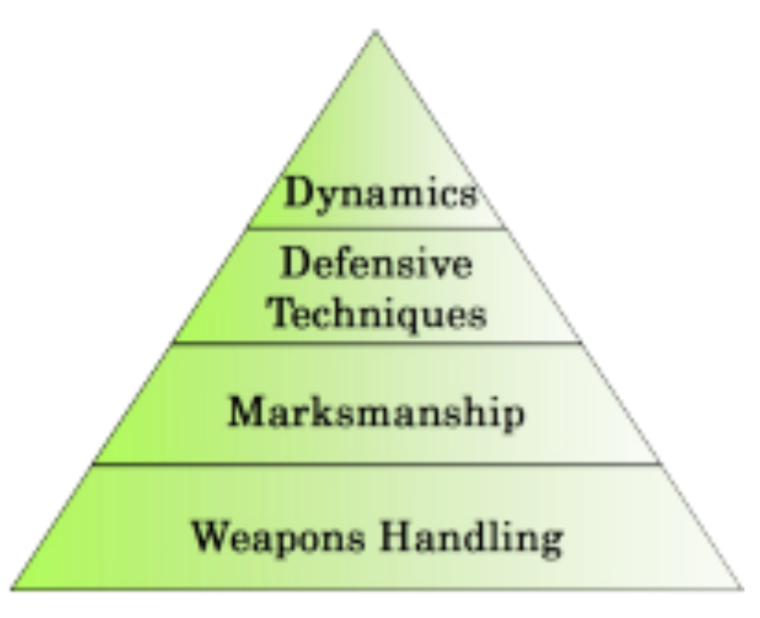
A pyramid is a solid, almost indestructible structure. In the same way, if you build your skill set in the fashion described here, it will be rock-solid, in the top 1% of gun owners.
Just like a real pyramid is supported by a wide, solid base, the skills at the bottom of the pyramid serve as the foundation for your skill set. Each level in the pyramid supports the levels above it, so the stronger your foundation, the easier it is to master the more advanced skills.
Weapons Handling
At the bottom of the pyramid is Weapons Handling. This is the foundation of your skill set, and as any builder will tell you, your foundation can never be too strong. These skills must be second-nature to you, because they serve as the basis for everything you will do with your gun. Weapons handling includes:
- Safety
- Muzzle Consciousness
- Trigger Finger
- Discipline
- Weapon Familiarity
- Chamber Check
- Magazine Check
- Grip
- Stance
- Operation of Controls
- Loading and Unloading
In my experience, the most common training mistake people make is thinking that they don’t need to work on Weapons Handling. In truth, a significant majority of shooting issues, and nearly 100% of safety issues, can be traced back to inadequate mastery of Weapons Handling.
Your foundation can never be too strong!
Marksmanship
Marksmanship, roughly speaking, is the ability to place your shot exactly where you want it. As a skilled marksman, you should be able to hit your target every time.
Now, you’ll notice I say you should be able to hit your target, but in reality, that doesn’t mean you will hit your target every time. After all, there are two types of shooters: those who miss and liars. But when a skilled marksman misses, they will know why they missed.
Well-rounded marksmanship involves shooting at small and large, near and far targets. As your marksmanship improves, you should constantly be challenging yourself with further and smaller targets.
So, you might ask, if you can hit a smaller, further target, why then would you need to practice against large, close targets? Because, in defensive marksmanship, you must not only be able to hit your target, but also do so quickly. Speed is an important element of defensive marksmanship, and you must learn to deliver your shots as rapidly as possible, while still ensuring you hit your target. So your marksmanship skill should include not only the ability to hit a small target from long range, but also the ability to hit a large, close target in under a second.
Defensive Techniques
Defensive techniques are the practical application of weapons handling and marksmanship to specific defensive situations. This is an extremely broad and diverse set of skills, many of which don’t even involve shooting, but all of which have a specific purpose or application. Here is just a portion of the skills in this category:
- Mindset and mental preparation
- Moral and ethical lethal force guidelines
- Psychological and physiological issues
- Legal considerations
- Post-encounter actions
- Escalation of force
- Primary and alternate shot placement strategies
- Carrying and presenting a handgun
- Using or presenting a rifle or shotgun on a sling
- Malfunction clearances
- Reloading procedures
- Alternate shooting positions
- One-handed techniques
- Low-light shooting
- Movement
This is by no means an exhaustive list, and there are even subsets within the skills listed. So you can see how much there is to this category. But if you have trained properly on the weapons handling and marksmanship skills that support defensive techniques, developing these skills won’t be difficult.
Dynamics
The capstone of your skill set is Dynamics, which is the ability to effectively apply defensive techniques to changing, unpredictable, and stressful situations. I divide the skills involved in Dynamics into three categories:
- Rapid decision-making
- Tactics (this is moving in and using your environment to your advantage)
- Stress Inoculation
Dynamics can only be effectively trained through stressful, realistic, and unpredictable training. Probably the simplest form of Dynamics training is adding stress through time pressure or competition. More advanced Dynamics training includes scenario-based training and simulators.
The best kind of Dynamics training is “force-on-force” training, which involves pitting your skills against another human being, using real weapons with simulated ammunition. This is the closest thing you can get to a real gunfight without real bullets flying. It tests every aspect of Dynamics under realistic conditions, and induces stress by imposing a physical (and mental) pain penalty when you get hit.
A word of warning about Dynamics training: This is the kind of training that everyone wants to do, because it’s fun, and because it’s a true test of your preparedness. A very common mistake that people make regarding their training is jumping into Dynamics too soon. You must build the supporting skills in the lower three levels to support Dynamics. You can’t build the top of a pyramid without the support beneath it. If you jump into Dynamics before you’ve built the supporting skills, you’ll just be wasting your time.
On the other hand, if you’ve built your pyramid from the bottom to the top, with a rock-solid foundation of weapons handling and proficiency in marksmanship and defensive techniques, Dynamics training becomes easy. Dynamics is simply the application of fundamental skills at a high level to a specific situation. The better your underlying skills, the easier it becomes.
Next time we’ll look at more training tips and defensive procedures.
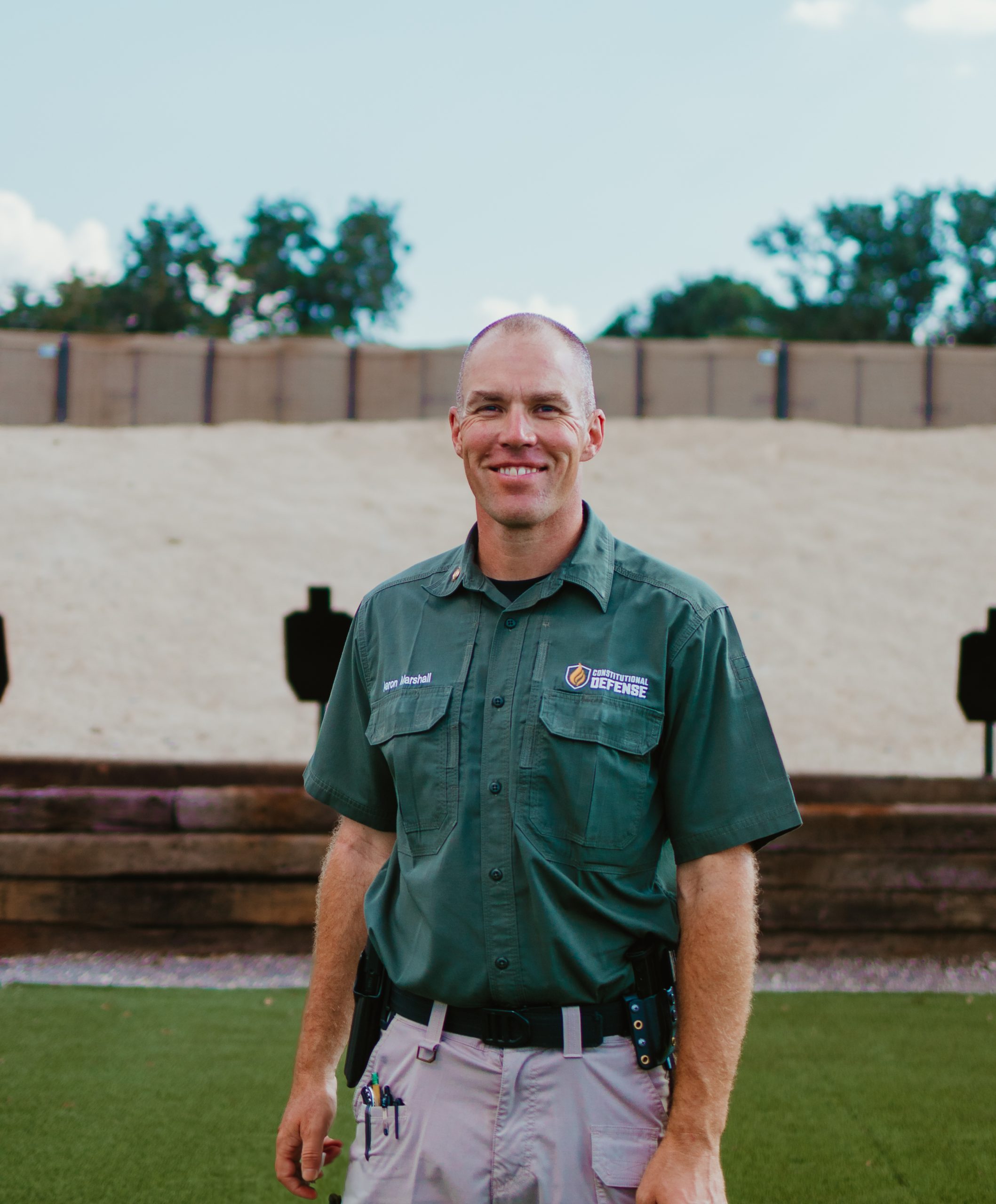
Aaron is a retired Army Reserve officer & a two-time combat veteran (Iraq & Afghanistan). He left a career in IT to become a firearms instructor. In over fifteen years as an instructor, he has trained soldiers and civilians, & attained instructor certifications from Glock, Sig Sauer, & the NRA Law Enforcement division. He also worked for three years as a full-time range master at Front Sight, the country’s largest private firearms school, and has personally trained over 6000 students. When he’s not teaching, he enjoys real estate investing, stock market trading, board games, and ballroom dancing with his wife Brandi.