
What’s the first rule of a gunfight? Bring a gun!
Whether you already have a gun or not, we’re going to discuss different criteria for a self-defense weapon. Why? It’s important that you have the best choice of self-defense weapon to protect yourself and those you love.
The first question you’ll want to answer is: handgun, shotgun, and/or rifle? Most people choose a handgun because of its portability and convenience. The downside is that they are woefully underpowered when compared to a shotgun or rifle. There’s an old saying that the purpose of the handgun is to fight your way back to your long gun. However, since it’s rather impractical (not to mention uncomfortable) to carry a concealed shotgun or rifle, the handgun is pretty much a necessity for protection anywhere other than on your own property.
Considering all of that, my suggestion is to own a handgun to carry with you when you leave home, and keep a long gun (a rifle or shotgun) for home defense. Given that a long gun packs far more punch than a handgun, you would do well to put that power at your disposal where practical to do so.
This post, we’ll look at some points about handguns specifically. Next time, we’ll dive into some points about rifles and shotguns.
Handguns: Revolver or semi-automatic?
When considering a handgun, first you’ll want to decide: Revolver or semi-automatic?
The following table gives you some points of comparison between semi-autos and revolvers. Keep in mind that these are general points, and there are exceptions with specific models of handguns, but this will give you a general sense of the pros and cons.
Semi-Auto
Revolver
Higher ammunition capacity
Lighter, easier trigger
Rapid loading and reloading
Three types of malfunctions
Uses a slide—requires practice to operate
Limited selection of calibers
Lower ammunition capacity
Longer, heavier trigger
More time-consuming loads
Only one type of malfunction
Uses a cylinder—simple to operate
Wide selection of calibers
I recommend a semi-automatic for 95+% of people. In my experience, the revolver simply takes more training, practice, and dedication to learn to run proficiently.
Unless you have a compelling personal reason why you need a revolver, you’re probably better off with a semi-auto.
Size
Since many people buy a handgun to carry concealed, they naturally gravitate towards a smaller gun. Likewise, people with small hands, particularly women, think they need a small gun. However…
Small guns are designed to be easy to conceal, not easy to use
In general, you should buy the largest gun that you can conceal, given your intended use of the gun.
Fit
This leads into the next point, which is that your gun should fit your hand. Obviously, the gun cannot be so big that you can’t get your hands around it. To check the fit of your gun:
- Hold the gun in your dominant hand, placing your hand as high on the grip as you comfortably can, with the gun forming a generally straight line with your forearm and the trigger finger placed along the frame above the trigger guard.
- Then, without moving your hand, place the pad of your trigger finger onto the face of the trigger. The trigger finger should comfortably rest on the trigger.
- Move the trigger finger back above the trigger guard. Repeat a few times. You should be able to move your trigger finger between these two positions without having to adjust your grip.
If the gun passes these two tests, congratulations! Your gun and hand are a good match.
Action
There are two basic action types for handguns: single action, and double action. Single action means that when you press the trigger, the hammer or striker falls, firing the shot. A double-action gun means that when you press the trigger, two things happen: the hammer or striker is first cocked, then dropped. Double-action guns will generally have a slightly heavier trigger. Single-action firearms typically feature a lighter trigger and often include a manual safety.
In general, I would advise that you stay away from double-action/single-action (DA/SA) guns. On these guns, the first trigger press is double action, meaning the hammer is cocked and dropped. On subsequent shots, the hammer will already be cocked, so the gun functions in single-action mode. These guns require you to master two different trigger presses. Simplicity is your friend when it comes to defensive shooting.
Caliber
If you are just getting started, I would recommend a 9MM handgun. It provides adequate ballistic power while being affordable, abundant, and having manageable recoil. 40S&W and 45ACP are also good choices for defensive rounds, but have the drawbacks of reduced ammo capacity, increased felt recoil, and higher cost.
There are plenty of urban legends about 9MM being an inadequate defensive round. However, the FBI did a comprehensive study published in 2013, which found no practical difference between 9MM, 40S&W, and 45ACP in terms of their relative abilities to stop an attacker. There is a reason 9MM is the most popular round used by law enforcement.
Models & Holsters
If you follow the guidelines above, the specific model of handgun you purchase is largely a function of taste and budget. Below are a few models that meet the criteria laid out in this section.
Glock 17
Glock 19
Smith & Wesson M&P
H&K VP9
Walther PPQ
Choosing a holster is a significant topic unto itself, so I’ll just make a few broad observations about choosing a holster. (And don’t even think of just tucking your handgun into your waistband or pocket and heading out the door! A holster is a necessity.)
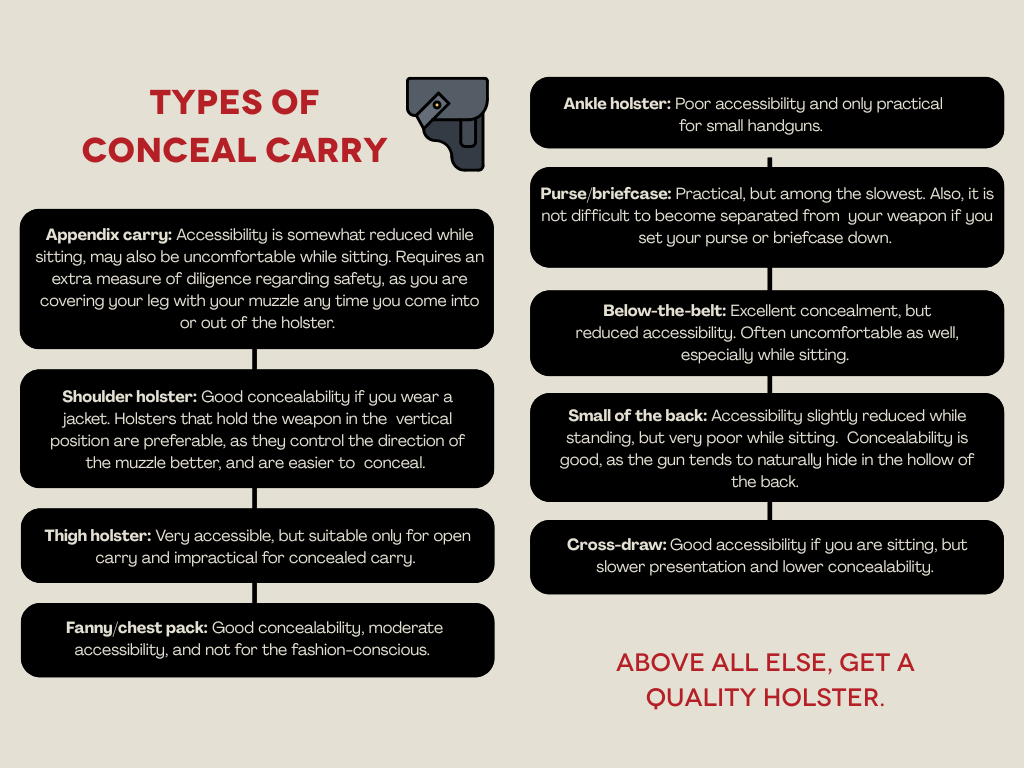
The first question you’ll want to answer is where you’ll be carrying your handgun. Choosing a carry location is about finding a balance between accessibility and concealability. Obviously, you’ll want your handgun to be easily accessible if you need it, but you must also ensure that it is concealed.
From an accessibility standpoint, the ideal place to carry a handgun is on your belt, worn on the point of your hip. Hip holsters come in two varieties: outside the waistband (OWB) or inside the waistband (IWB). Outside the waistband are more accessible, but less concealable, and vice versa for inside the waistband.
This type of holster may not by practical for you considering your lifestyle and typical attire. Here are a few other options for carry position to consider
Extra Ammo
There are two things you never have enough of in a gunfight: time and ammunition. Carrying extra ammunition is prudent in case you find yourself facing off against multiple adversaries.
For a handgun, this is a matter of carrying extra magazines with you, usually in a pouch or pocket. A good belt magazine carrier is not very expensive and keeps extra magazines readily accessible. If you are keeping your handgun for home defense, you are naturally not going to take the time to strap on your magazine pouch, so you’ll just need to stash an extra magazine or two near your firearm, or in your safe room.
Next Up: Shotguns & Rifles
This was more technical in nature, but hopefully you walk away from this with a better understanding of what you’ll need to have if you’re serious about carrying in self-defense. Next time, we’ll cover the long guns: shotgun and rifle.

Aaron is a retired Army Reserve officer & a two-time combat veteran (Iraq & Afghanistan). He left a career in IT to become a firearms instructor. In over fifteen years as an instructor, he has trained soldiers and civilians, & attained instructor certifications from Glock, Sig Sauer, & the NRA Law Enforcement division. He also worked for three years as a full-time range master at Front Sight, the country’s largest private firearms school, and has personally trained over 6000 students. When he’s not teaching, he enjoys real estate investing, stock market trading, board games, and ballroom dancing with his wife Brandi.